Change Experts Academy
Our First Offering will focus on saving lives through Ketamine Treatment.
"Ketamine Neuroplasticity Mastery"
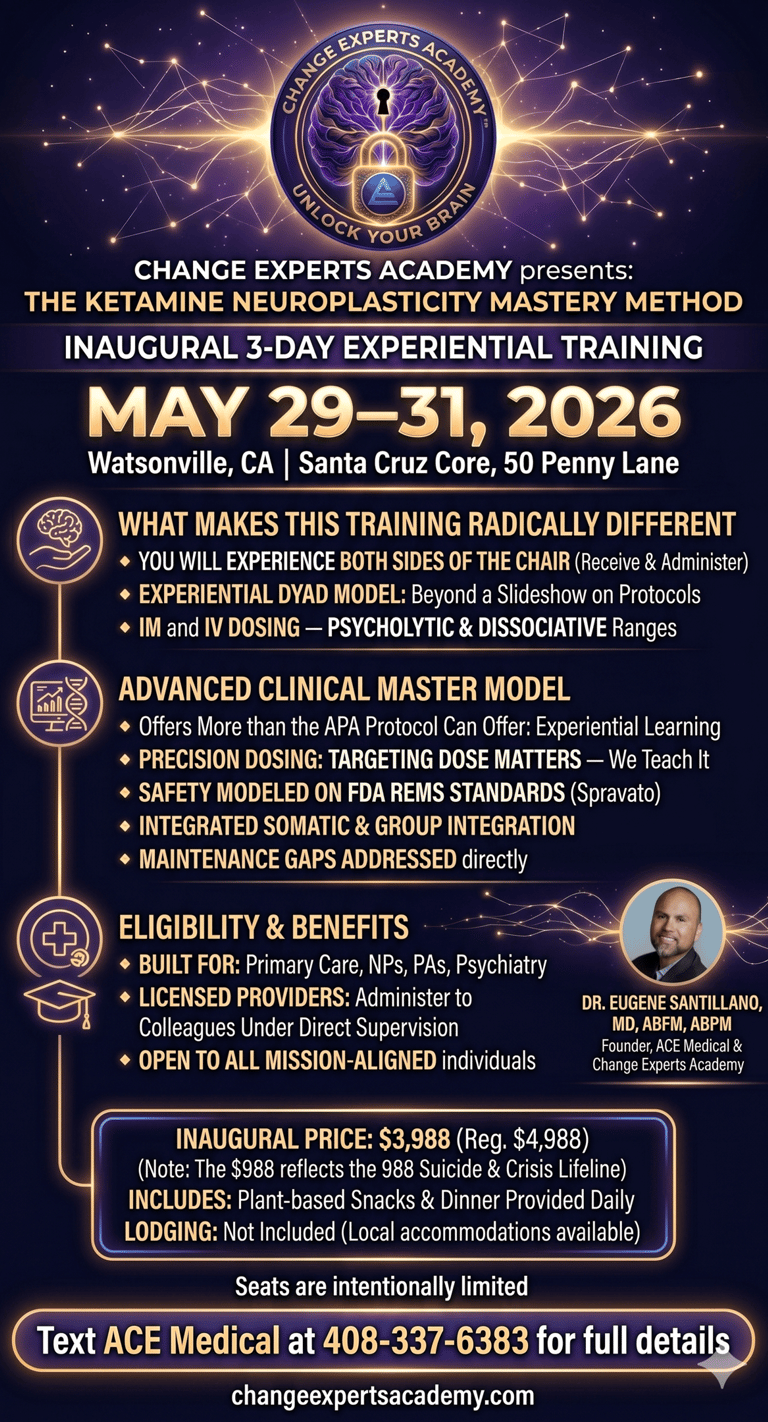
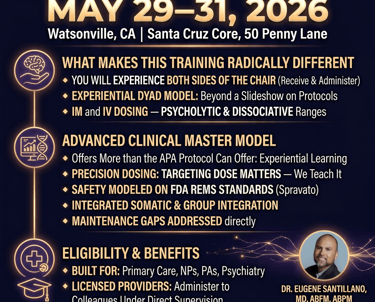
is the first offering from Change Experts Academy targeting medical professionals interested in learning about using ketamine beyond its application as a medication.
FAQs
What is ketamine?
Ketamine is a medicine derived from PCP. This chemical has been used safely as an anesthetic approved by the FDA since 1970 and is classified as a Dissociative Anesthetic.
Sprivato is esketamine, a nasal spray version of ketamine that is FDA approved for Treatment-Resistant Depression and Depression with Suicidal Ideation.
Ketamine has been used in the Emergency Department for rapid onset and effective pain management for minor procedures in adults and children!
Ketamine opens a neuroplastic window that no other medication used in depression can reliably produce.
This window allows:
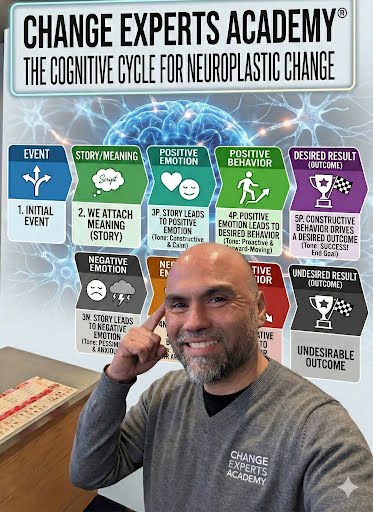
Temporary uncoupling of the rigid thought state of cognitive entrapment—where the brain cannot imagine relief, alternative futures, or safety from pain.
Neuroplasticity with re-engagement of the prefrontal cortex (decision center) and emotional/memory/identity centers of the brain
Opportunity for meaning, choice, and self-compassion to land
Ketamine does not replace treatment; it creates access to it.
Who can benefit?
Is ketamine safe?
WHY OUTCOMES VARY (AND WHY TRAINING MATTERS)
What is Ethical Ketamine?
The Majority of the effects are temporary, and if we recognize that the EFFECTS of medications are often labeled as SIDE EFFECTS, we know that the EFFECTS will come and go.
The short-term effects include increased blood pressure and heart rate, as well as distortions of thinking, including auditory and visual imagery. Short-term cognitive effects, such as decreased attention and impaired motor skills, usually resolve within 2 hours. At the low dose recommended for Mental Health compared to Anesthesia, this is a well-tolerated medication with an excellent safety profile.
High dose and DAILY administration of this medication has been associated with bladder and urinary tract issues like ulcerative or interstitial cystitis with long-term, off-label misuse of ketamine.
Isn’t ketamine addictive?
Unstructured and recreational use carries risk. Structured, trauma-informed, purpose-driven use reduces harm—especially compared to untreated despair.
Spravato R.E.M.S. provides a protocol to deliver ketamine with an ethical practice. This is not home based, self dosed medication. The medication is delivered to a provider that will administer (or observe) the medication and monitor the client for 120 minutes to support safest use.
Ketamine, like other psychadelic medications, is likely to cause symptoms of altered perceptions. Safety is an important part of receiving ethical ketamine.
Off-label use of Ketamine has many potential uses.
We will review many possible indications, including
Treatment-Resistant Depression
Suicidal Ideation
Anxiety Disorders (PTSD, Generalized Anxiety, OCD, Panic Disorder, Bulimia, Anorexia Nervosa, Body Dysmorphic Disorder)
Addiction (Alcohol -including WD support, Opiate Use including Fentanyl transition to Buprenorphine, and even Food Disorders). This is not the topic of the Ketamine Neuroplasticity Mastery. This will be part of the future Addiction modules
There’s not enough long-term data
You are correct—and that absence is a funding problem, not a failure of clinical observation. Waiting for perfect data while patients die is not neutrality. It is a decision.
The Medication Isn’t the Variable. The Delivery Is.
Outcomes vary because:
Providers are taught to avoid dissociation rather than understand it
Ethics are framed as restrictions, not responsibility
Integration is optional instead of essential
Fear replaces fluency
Avoiding dissociation does not make ketamine safer. Avoiding education does.